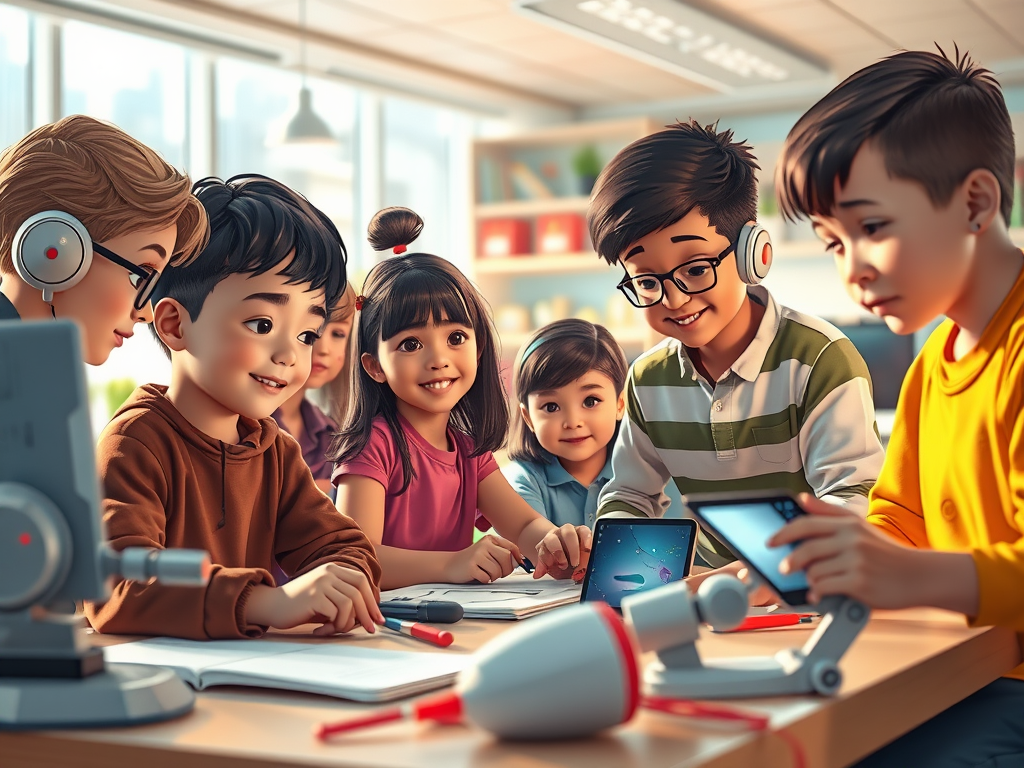
Here’s a fun bit of math. A child who starts school in 2026 will finish around 2040. Now, quick show of hands: who among us can confidently predict next Tuesday? Exactly. Jobs are vanishing, careers are being automated, and AI is improving by the hour, not the year. The World Economic Forum expects more than a fifth of today’s jobs to be disrupted by 2030 alone, with 170 million new roles created and 92 million disappearing. And into this whirlwind we send our children armed with… a 1995 curriculum and a sharpened pencil.
Godspeed, little soldiers.
The Curriculum Time Forgot
Think about what school still asks of a child. Sit still. Be quiet. Memorize these facts. Follow these instructions. All of this while the child carries a device in their pocket that knows every fact ever recorded and can also order pizza.
We reward silence over curiosity and conformity over creativity, then hand out certificates for it. To be fair, this is excellent preparation… for 1995. If anyone ever invents a time machine, our children will be phenomenally employable on the other side of it. Until then, we have a problem: we’re using a model built for the past to prepare kids for a future nobody can predict.
Children Are Not Products
The current system runs like a factory, and not subtly. Children arrive in batches sorted by date of manufacture, move along the conveyor belt to the sound of bells, get tested for uniformity, and are stamped for quality at the end.
Except children are not products. They are inventors, explorers, and the seeds of a world we haven’t imagined yet. And here’s the uncomfortable part: most of what they’re memorizing won’t matter in 15 years, while the things that will matter barely make the timetable. Emotional intelligence. Critical thinking. Adaptability. Character. Purpose. You know, the small stuff.
The Elephant in the Classroom
Meanwhile, the future has already walked into the classroom without signing the visitors’ book. Surveys in the United States now find that around seven in ten teenagers use AI for schoolwork, yet only three in ten say a teacher has ever discussed how to use it well. And most teens report that classmates using AI to cheat is simply part of school life now.
The standard institutional response has been to ban it, which works about as well as banning the tide. Here’s the uncomfortable truth: if a chatbot can do the homework in eight seconds, the problem isn’t the chatbot. It’s the homework. It was testing recall in a world that has quietly outsourced recall. The real assignment for schools is to teach children to use AI the way a carpenter uses power tools: skillfully, deliberately, and with full awareness of where their fingers are. A child who learns to question AI’s answers, check its facts, and know when to ignore it entirely will run circles around the child who was simply told “don’t.”
What 2040 Will Actually Ask of Them
Nobody knows exactly what jobs will exist in 2040, which is precisely the point. The only sensible preparation for an unpredictable world is a child who can handle unpredictability.
The data agrees. The same World Economic Forum research estimates that nearly 40 per cent of the skills workers use today will be transformed or outdated by 2030, before our 2026 school starters even sit their final exams. And the skills employers say they’ll want most? Analytical thinking, resilience, flexibility, and creative thinking. Notice what’s missing from that list: sitting still and memorizing.
So that means raising kids who ask good questions, which, in the age of AI, has quietly become more valuable than knowing answers. Kids who can adapt when the ground shifts, because it will. Kids who can collaborate, solve messy problems that don’t come with a marking scheme, and comfort a crying friend, a skill no robot has mastered and none is close to. If we keep teaching for the world that’s leaving instead of the one that’s arriving, we’re not preparing our children for the future. We’re lovingly preparing them for a world that has already left the building.
What Parents Can Do Tonight
The curriculum may take a decade to catch up. Your dinner table can start this evening, and none of it costs a shilling:
- Reward questions, not just answers. Ask things with no single right answer (“what would you redesign about your school?”) and celebrate the reasoning, not the conclusion.
- Let them build, break, and get bored. Boredom is where imagination goes to stretch its legs. Resist the urge to schedule every gap.
- Use AI together, not in secret. Ask a chatbot something as a team, then ask the better question: “How do we know if that’s right?” Fact-checking a confident machine is critical thinking with training wheels.
- Let them fail small. A collapsed cake, a lost match, a flopped project. Small failures now are resilience reps for the bigger ones later.
- Let them see you learning. Nothing teaches adaptability like watching a parent be a cheerful beginner at something.
Let Them Move
So let them move. Let them question everything, including us, especially us. Let them experiment, build, break things, and build better ones. Give them classrooms that feel less like assembly lines and more like workshops.
The year 2040 is coming whether our curriculum shows up for it or not. The only thing more dangerous than being unprepared is pretending we still have time to waste. Our children are ready to build the world we never could. The least we can do is stop teaching them how to live in the one that’s gone.


